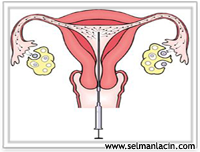
Insemination is actually a process performed to support physiology to increase the chance of sperm and egg meeting. While the number of eggs that occur spontaneously every month is increased to two or three with the pills or injections given to the woman, the man's sperm are washed and prepared with some special methods.
In this way, the motile sperms are concentrated in a small volume. The sperms, which have been prepared by adjusting the hatching time of the eggs with the cracking needles to be given, are deposited into the uterus through a special plastic tube, thus shortening their journey so that they can easily reach the egg or eggs. It should be well known that vaccination cannot be given to every childless person.
Pre-vaccination assessment
Examinations to determine the cause of infertility in couples applying for infertility:
In men: Semen analysis (spermiogram)
In women:
- gynecological examination,
- Uterine film (HSG) to evaluate the uterus and tubes
- Hormone tests to evaluate the capacity of the ovaries,
- In some special cases, diagnostic laparoscopy or hysteroscopy may be performed.
In what cases is vaccination (IUI) applied?
IUI is the first choice method in many infertility cases as it is an easy-to-apply, practical, relatively economical and risk-free procedure.
Most often:
1. Low sperm count or motility rate (Male factor).
2. Endometriosis.
3. Unexplained Infertility
4. Cervical problems.
5. Presence of antibodies against sperm (Immunological Infertility).
6. Absence or insufficient ovulation in women (Ovulatory Factor).
7. Sexual dysfunctions
Vaccination is the preferred method in all these cases. Vaccination is a method sometimes used in men with ejaculation problems. Ejaculation problems may be caused by diabetes, multiple sclerosis, trauma, retrograde ejaculation, a disease in which sperm is discharged into the bladder, bladder neck operations, and some medications. Although insemination seems to be a simple procedure, it is beneficial to have it performed by a gynecologist who is experienced in this regard.
What is the success rate of vaccination?
The success rate of the vaccination process is around 10-15% for each attempt. Every couple who starts vaccination should know that this rate is not higher, and they should not be disappointed when pregnancy does not occur.
How many times can vaccination be done?
The number of attempts is adjusted according to the reason for the application, the needs of the couple and their economic situation.
Of course, in order for this process to be performed, at least one channel or tube must be open. Therefore, it is also necessary to take a uterine film before the vaccination process. Today, the accepted view is to perform the vaccination 2, at most 3 times. People who are not thought to benefit from insemination or who do not become pregnant despite insemination 2-3 times should definitely proceed with in vitro fertilization treatment.
How important is sperm quality in insemination?
If the number and movement of the man's sperm is very low, the benefit to be expected from vaccination is very low..! Although there is no consensus on this number and movement, the generally accepted view is that after the washing process is applied to the man's sperm, the rate of forward moving sperm should be at least over 1 million per ml. Another important issue is sperm deformities. Before insemination, sperm shapes should be evaluated in detail in dyed samples by people experienced in this field, and the number of normal-looking sperm should be at least 4-5%. Even if the number and movement of sperm that are not normally shaped are good, there may be problems in them penetrating the egg shell and entering inside.
Washing Sperms (Preparation)
The semen taken from the man for insemination is purified from all secretions other than sperm by subjecting it to washing processes called flotation or gradient in the laboratory. Thus, it is cleared of substances that can cause severe uterine contractions and bacteria that can cause infection in the uterus. In addition, by collecting the moving ones in a smaller volume, their movement rates are increased. Sperm washing application increases the sperm's ability to fertilize the egg. The washed sperm are placed in a very small amount (0.5 cc) of culture liquid and become ready for inoculation, with both their number and mobility increased.
How is Insemination (Intra Uterine Insemination - IUI) done?
Vaccination is a simple procedure and takes only a few minutes. After the woman lies on the examination table, the doctor inserts the speculum into the vagina and injects the specially prepared (washed) sperm directly into the uterus through a catheter (tube). This allows sperm to reach the tubes where fertilization occurs more easily. If a woman experiences irregular ovulation, the doctor may prescribe medications that stimulate ovulation. If there is an unexplained problem, in order to increase the benefit from vaccination, the woman's egg, which would normally develop only one, can be increased to 2 or 3 with medications (pills or injections). If more eggs develop, vaccination will not be appropriate. Because the possibility of multiple pregnancy will increase. In our center, ovarian stimulation is performed with an injection in women with normal menstruation in order to stimulate the ovaries. If IUI (insemination) is applied together with the use of these drugs to increase the probability of fertilization, it is seen that pregnancy rates increase in couples with no cause for infertility.
What are the problems that may arise with hanging?
If more than 3 eggs develop despite being checked, then the treatment should either be canceled and intercourse prohibited for that month, or the treatment should be changed to in vitro fertilization treatment. Otherwise, multiple pregnancy may occur. A final option may be to inoculate the remaining eggs by aspirating (destroying) the excess eggs. All these options are rare cases that are normally extremely little used.
Another undesirable condition is the "Overstimulation Syndrome" (OHSS), which is characterized by excessive enlargement of the ovaries, excessive increase in hormone levels, and fluid accumulation in the abdomen. In this case, hospitalization and special treatment may very rarely be required.
Another problem that is very unlikely to develop after vaccination is inflammation (infection). If insufficient attention is paid to the cleanliness of the vagina and cervix during vaccination and if vaccination is performed in a microbial environment, such a problem may rarely be encountered. Therefore, the physician must be careful in this regard and strictly comply with hygienic rules.
When should a pregnancy test be done?
The result is investigated with a blood pregnancy test 2 weeks after vaccination. It is generally recommended to use progesterone vaginal tablets or gel during this 2-week period. In case of pregnancy, an ultrasound should be performed after 3 weeks to see the fetus and heartbeat.
As a final word, I would like to remind you that the expected benefit from vaccination, that is, the probability of pregnancy, is 15-20% for women with ovulation problems and 10-15% for women with unexplained type problems. These rates should be clearly stated at the beginning of double vaccination and it should be ensured that they do not expect more than necessary.
For detailed information and consultation on the subject Click here. or vaccination.org You can reach us from our website