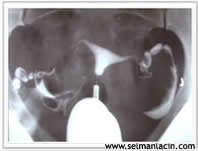
My ducts were blocked in the Rahim movie. Can't they be opened?
HSGIf the tubes are closed in the uterine film, there are two possibilities. First, the tubes are not actually closed and appeared to be closed due to the spasm caused by the pain and excitement felt during filming.
A physician experienced in the subject can actually tell, by looking at the film, whether the obstruction seen is real or not. However, sometimes a definitive interpretation cannot be made, and in order to fully evaluate this situation and try to open it, the inside of the abdomen is examined with laparoscopy.
Since laparoscopy is performed under general anesthesia, there is no pain or spasm and the true condition of the tubes is clearly understood. If the dyed substance (usually sterile methylene blue) administered while the patient is under anesthesia passes through the tubes easily, that is, if the tubes are open, the procedure is terminated.
In the second option, during laparoscopy, it is determined that the dyed material administered as if taking a uterine film does not pass through the canals, that is, the tubes are actually closed. In this case, the doctor tries to open the tubes by using different tools during the operation. Opening the tubes is often successful, depending on the surgeon's experience, but nothing definitive can be said about this in advance.
If the tubes were opened during the operation and pregnancy did not occur after waiting for at least 3 months and at most 9 months, in vitro fertilization treatments should be considered. If the operation is not successful, that is, if the area around the tubes is highly adherent, the procedure is terminated and the couple is directed directly to in vitro fertilization treatment.
It has been suggested in various studies that up to 20% of the occlusions seen on the uterine film are actually pseudo-occlusions due to spasm.
If only one of the channels is clogged, other factors should also be evaluated carefully. The man's sperm status, the woman's age, and the duration of her desire for a child are also important factors affecting the treatment decision. The benefit of waiting for children older than 35 years and for more than 5 years is debatable, and it is better not to delay to switch to effective treatments.
If the uterine film shows not only closure but also fluid accumulation in the tube called hydrosalpinx, then that tube must be removed by laparoscopy or its connection with the uterus must be cut, considering that this fluid will reduce pregnancy rates even if in vitro fertilization treatment is applied.